
Biotech announced US$245B of licensing deals in 2026 so far. It wired US$17.5B. Every press release you read this year lives somewhere in the gap between those two numbers.
I went through all 170 licensing, collaboration and asset deals in the BioBucks tracker from 1 January to 9 November 2026. Here is what the money says once you stop reading the headlines.
The short version
- Six cents on the biobuck. The median deal paid US$72M at signing against a US$1.2B headline. The other 94 cents are waiting on milestones, and milestones are patient.
- China is the market. China-origin assets were 39% of deals, 67% of headline value and 60% of upfront cash. Nine of the ten largest packages came out of China.
- Everyone is shopping early. 62% of deals were discovery or preclinical, and they carried 75% of headline value. Phase 3 and later was 6%.
- The US$1B club has a low cover charge. 80 deals carried a ten-figure headline. Fewer than half paid US$100M upfront, and 11 disclosed no upfront at all.
- Lilly buys the most, Roche shows its working. Lilly signed 17 deals and Roche 15. Roche disclosed the upfront on 14 of them. Lilly managed 9.
The full 23-slide deck sits alongside this post. What follows is the commentary I would give if you cornered me at the conference bar.
Get the full 23-slide deck
Every chart behind this post: the total market, China only, and what is being bought. 1 January to 9 November 2026.
US$245B announced, US$17.5B wired
The industry has a word for the first number: biobucks. I liked it enough to name the newsletter after it.
Of 170 deals, 147 disclosed a headline value and 114 disclosed an upfront. Add them up and upfront is about 7% of headline. Take the median deal and it is closer to 6%: US$72M today, US$1.2B if everything works, which in drug development is a generous use of the word “if”.

The US$1B headline used to mean something. This year 80 deals cleared it, and the upfronts behind them look like this:
| Upfront on a US$1B+ deal | Deals | Share |
|---|---|---|
| US$100M or more | 37 | 46% |
| US$50M to under US$100M | 12 | 15% |
| Below US$50M | 20 | 25% |
| Not disclosed | 11 | 14% |
Eleven companies announced a ceiling and declined to mention a floor. That is a mood, not a valuation.
It is also getting more common. Upfront was disclosed on 72% of first-quarter deals and 75% of second-quarter deals, then 55% in the third. When the number is good, people tend to share it.
China: four in ten deals, six in ten upfront dollars
If you still think of China as the place to pick up cheap preclinical assets, your mental model needs a software update.
Sixty-six deals had a China-based licensor. That is 39% of the count, 67% of headline value (US$164B) and 60% of disclosed upfront (US$10.5B). Twelve of the 19 upfronts of US$300M or more went to China-based licensors. The median disclosed upfront was US$94M for China-origin deals and US$57M for everyone else.

The top of the league table makes the point without help:
| Partner / licensor | Headline | Upfront |
|---|---|---|
| AstraZeneca / CSPC | US$18.5B | US$1.2B |
| Roche / Hansoh | US$15.5B | US$400M |
| Bristol Myers Squibb / Hengrui | US$15.2B | US$600M |
| Pfizer / Innovent | US$10.5B | US$650M |
| Lilly / Innovent | US$8.9B | US$350M |
| Sanofi / Regeneron | US$8.0B | US$1.0B |
| Novartis / Abogen | US$7.8B | US$575M |
| Boehringer Ingelheim / SBP Group | US$7.4B | US$358M* |
| AbbVie / RemeGen | US$5.6B | US$650M |
| Madrigal / Ribo | US$4.5B | US$60M |
Regeneron is the only non-Chinese licensor on the list, and it needed Sanofi and a ten-figure cheque to get there. Those ten deals are 41% of all headline value this year. (* Boehringer’s figure includes near-term payments.)
Four more things worth knowing:
- It is early-stage. 42 of the 66 deals were discovery or preclinical. Preclinical assets alone were 55% of China-origin headline value.
- Three buyers did the heavy lifting. AstraZeneca, Roche and Lilly took 17 deals and US$68B between them. AstraZeneca paid the most cash: US$2.0B of upfront across four deals.
- Repeat sellers run the show.Ten licensors signed 27 deals worth US$109B. Insilico signed five, Haisco four, Innovent and Sino Biopharmaceutical three each. At this point Innovent’s BD team deserves its own ticker.
- The China carve-out is no longer automatic. 28 deals kept Greater China for the licensor. 26 handed over worldwide rights, home market included.
Then there is the NewCo route. Six assets went into purpose-built Western vehicles instead of a pharma pipeline: Avere, Sentivera, Boulevard, K2, Serapha and Kenmare. Combined headline of about US$8.7B on US$236M of disclosed upfront, with the licensor often paid partly in equity. If you cannot find a buyer, your investors will build one.
An early-stage market, priced through structure
Pharma spent 2026 buying things that have not met a patient yet. 105 of 170 deals were discovery or preclinical, and they carried three-quarters of the headline value.
The pricing of that risk does not show up in the headline. It shows up in how much of the headline arrives on day one.
| Stage of lead asset | Deals | Headline value | Median upfront as % of headline |
|---|---|---|---|
| Discovery / platform | 61 | US$82.6B | 4% |
| Preclinical | 44 | US$100.9B | 4% |
| Phase 1 to Phase 2 | 34 | US$46.9B | 7% |
| Phase 3, filed or marketed | 31 | US$15.1B | 19% |
Read that table twice. Preclinical deals have the biggest headlines and the smallest cash share. Late-stage deals have the smallest headlines and nearly five times the cash share. The headline scales with ambition. The upfront scales with evidence.
It also means late-stage assets are scarce. Only 31 deals involved something in Phase 3 or beyond, and together they were 6% of headline value. De-risked assets either cost real money or get acquired outright, which is a different tracker.
The buyers: Lilly shops, Roche shows receipts
Lilly and Roche signed 32 deals between them, more than the next four partners combined.
| Partner | Deals | Headline value | Upfront disclosed on |
|---|---|---|---|
| Eli Lilly | 17 | US$31.1B | 9 of 17 |
| Roche / Genentech | 15 | US$34.8B | 14 of 15 |
| Novartis | 7 | US$18.7B | 5 of 7 |
| Boehringer Ingelheim | 7 | US$11.0B | 2 of 7 |
| GSK | 6 | US$3.4B | 4 of 6 |
| AstraZeneca | 5 | US$25.2B | 5 of 5 |
| AbbVie | 5 | US$9.0B | 4 of 5 |
Two styles are on display. Roche tells you what it paid almost every time. Lilly and Boehringer prefer “up to”, which is a phrase that does a lot of work in this industry.
AstraZeneca is the outlier in the other direction. Five deals, US$25.2B of headline, upfront disclosed on all five, including the largest package of the year with CSPC. Fewer swings, bigger bat.
What is actually being bought
Oncology took 41% of headline value: 49 deals and US$100B. No surprise there. The surprise is the tie for second. Immunology and inflammation came in at US$44.1B and cardiometabolic at US$43.3B, and cardiometabolic got there with 15 fewer deals.
By modality, the count and the cash tell different stories.
| Modality | Deals | Headline value |
|---|---|---|
| Small molecules | 43 | US$42.0B |
| Antibody-drug conjugates | 9 | US$39.7B |
| Bispecifics and T-cell engagers | 21 | US$35.1B |
| Peptides and macrocycles | 11 | US$32.1B |
| Monoclonal antibodies | 22 | US$27.9B |
| RNAi and oligonucleotides | 10 | US$14.1B |
| AI and data-driven discovery | 21 | US$13.0B |
ADCs were 5% of deals and 16% of headline value. Nine ADC deals were worth almost as much as 43 small-molecule deals. Small molecules remain the industry’s reliable hatchback: everywhere, useful, and nobody posts about them.
The quieter shift is in multispecifics. Eight of the 21 bispecific and T-cell engager deals were in immunology, and those eight carried half the category’s value. Novartis / Abogen, an mRNA-encoded CD19 x CD3 engager at up to US$7.8B, is the largest multispecific deal of the year in any indication. The T-cell engager has left oncology and is not asking permission.
Three side plots: AI, obesity and Korea
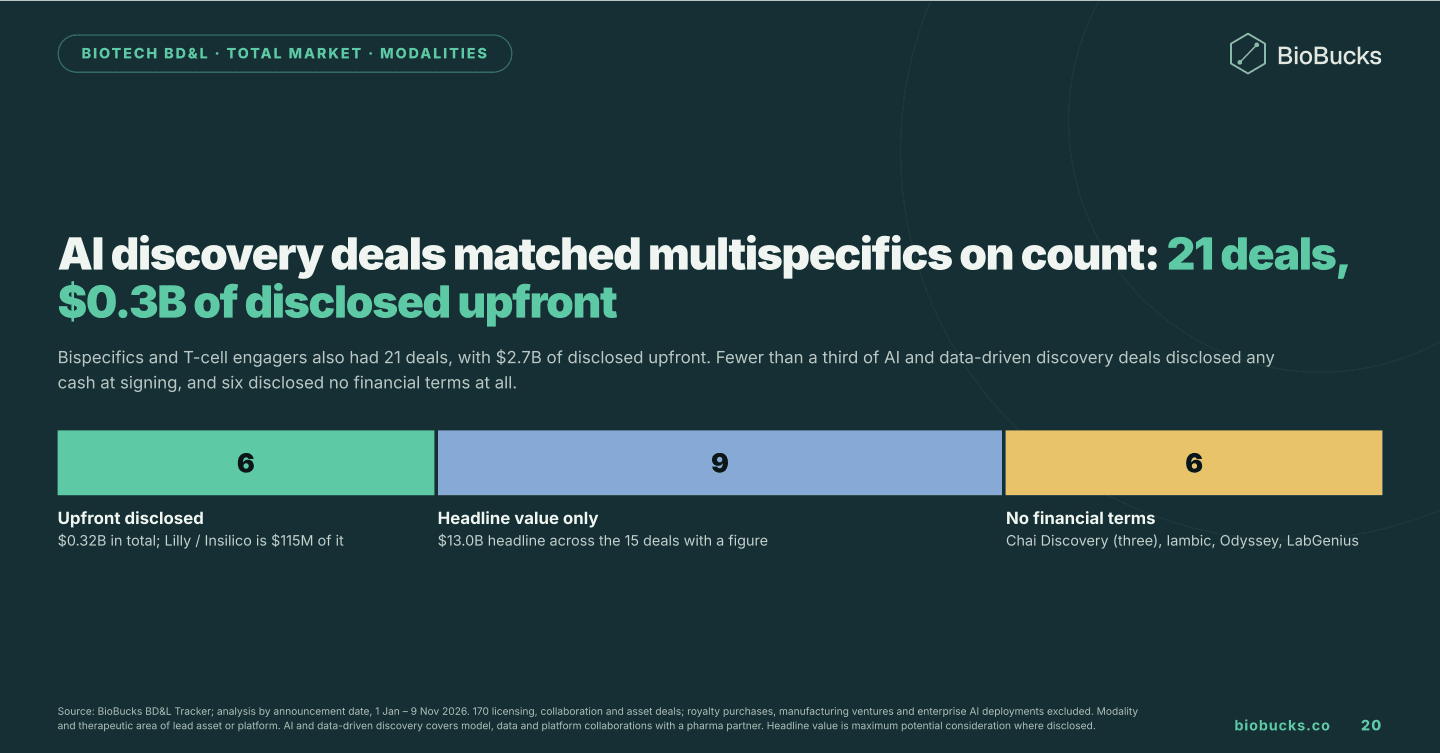
AI: lots of handshakes, not much cash. AI and data-driven discovery matched multispecifics on deal count, 21 each. Disclosed upfront was US$0.3B for AI against US$2.7B for multispecifics. Only six AI deals disclosed an upfront, and Lilly / Insilico was US$115M of the total. Six disclosed no financial terms whatsoever. Pharma is clearly interested in AI. It is just not yet interested in paying for it up front.
Cardiometabolic: no house style. Twenty deals, US$43B, and the eight largest span injectable peptides, oral small molecules, siRNA, macrocycles and AI target discovery. Nobody knows which modality wins the next leg of the obesity market, so everybody is buying one of each. Novo Nordisk signed four deals in 13 days in September, three of them with no disclosed upfront.
Korea: small numbers, real money. Nine deals and US$8.8B from Korea-based licensors, with Hanmi in three of them alongside Roche, Lilly and BioMarin. Korean licensors had a median upfront of about 15% of headline against 6% for the market, because more of what they sold was already in the clinic.
What to do with this
- If you are selling: benchmark the upfront, not the headline. At preclinical stage the median is about 4% of headline. If you are being offered less, the headline is decoration.
- If you are buying: your real comparables are increasingly Chinese. Twelve of the 19 largest upfronts this year went to China-based licensors.
- If you are reading press releases:find the second number. If there isn’t one, that tells you something too.
The headline is marketing. The upfront is conviction.
How I counted
Data comes from the BioBucks BD&L tracker, by announcement date, 1 January to 9 November 2026. The base is 170 licensing, collaboration and asset deals. Royalty purchases, manufacturing ventures, enterprise AI deployments, amendments and term sheets are excluded.
Headline value is the maximum potential consideration where disclosed. Upfront uses the disclosed figure, which in 24 cases is combined with near-term payments or equity. China-origin means a China-based licensor or seller, including dual headquarters and Hong Kong. Stage, therapeutic area and modality are assigned by lead asset. The buyer table covers licensing and collaboration deals only.
Full tracker, deal by deal, at biobucks.co.